Opportunistic Hiring


"Opportunistic Hiring" is where you hire someone because you see an "opportunity", not necessarily because they meet a clearly scoped need in the organization. My take: unless you really know what you are doing, avoid it.
Cursor Rules
Back in November, Brie Wolfson wrote a deep-dive on Cursor in Colossus. This bit on their hiring practice caught some attention:
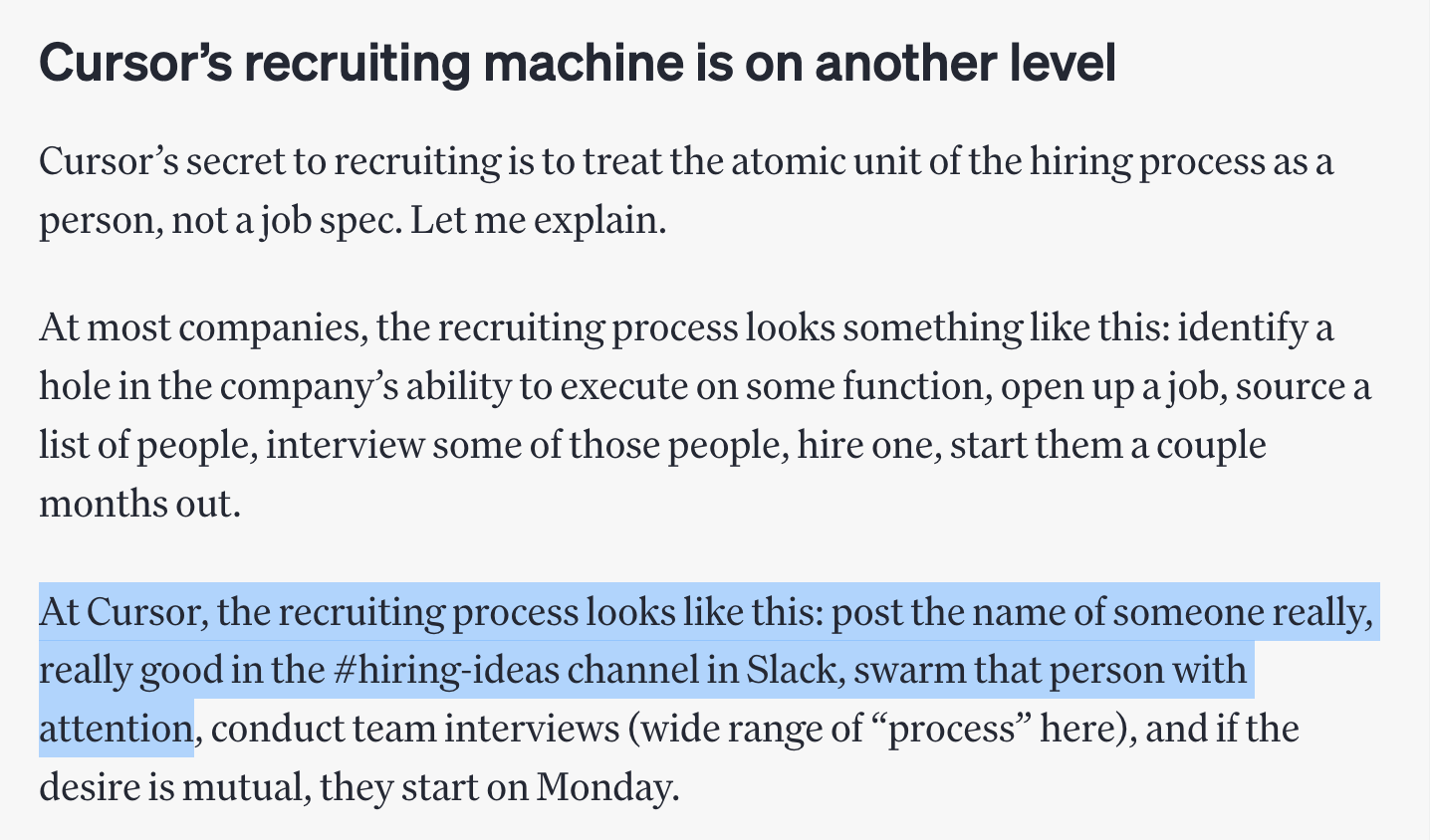
Erik (from a16z) agrees:
This is how you hire an org of superstars. People first, roles/process second.
— Erik Torenberg (@eriktorenberg) November 16, 2025
There are many ways to put the puzzle together, but you want to prioritize top talent above all. It’s easier to deal with the chaos of non-standardized processes than it is to find & convince top… pic.twitter.com/aY5T1jAUqS
Some time later, I was listening to Naval's podcast "Curate People" where he touched upon something similar when talking about hiring "geniuses only":
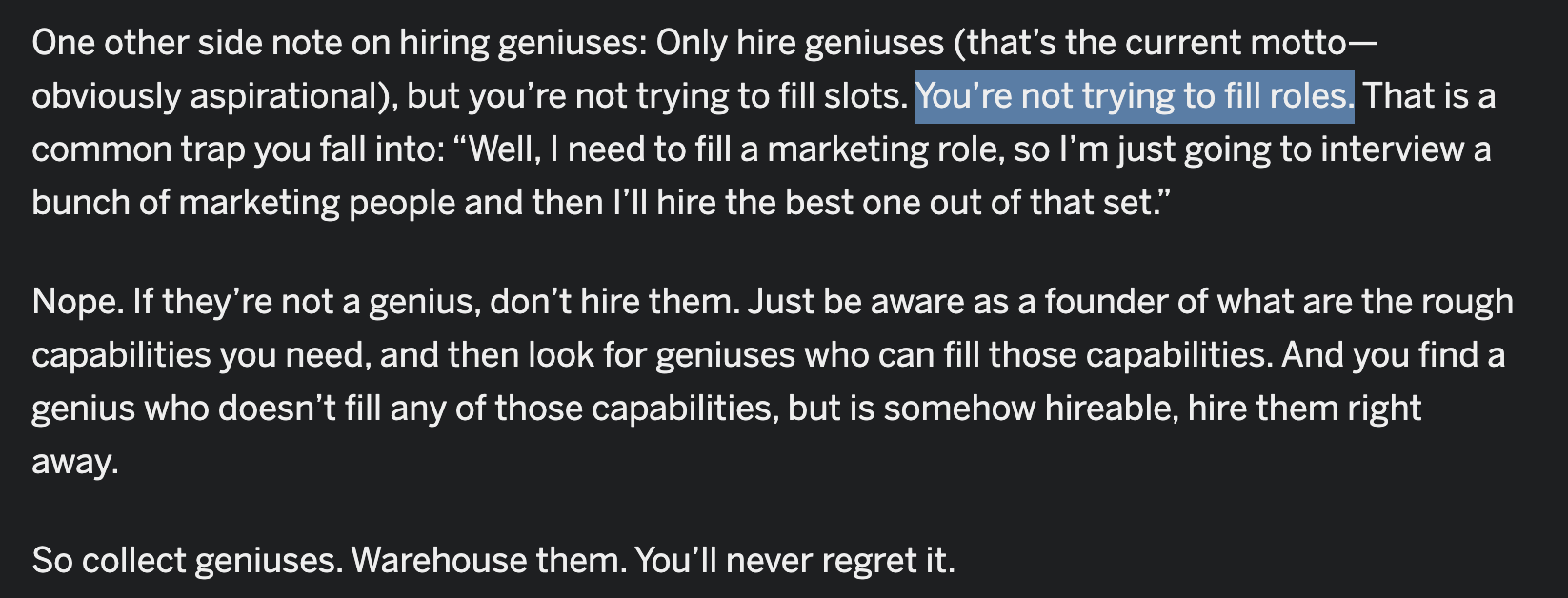
I had some reservations though. My friend Nakul offered a counterpoint, which I added on to:
Yeah "People first, roles/process second" only really works when you're growing quickly + the skills are relatively "fungible" (e.g. full-stack SWE) + early / mid-career talent.
— Diwaker (@diwakergupta) November 17, 2025
But there are many many failure modes in "opportunistic hiring" esp. at specialized domains / senior…
Now, I'm not saying opportunistic hiring doesn't work and I'm sure Naval and Cursor know what they are doing. What I am saying is that Naval and Cursor are anomalies, that there are many failure modes in opportunistic hiring and for the vast majority of startups, it might not work.
Allow me to elaborate.
Bitter Lessons
You're a series B/C company, you are growing fast. There's plenty of VC cash and pressure to grow is high. There's more work than you have people. You have a hiring budget and recruiters to help. You figure you'll always have work for an awesome engineer or designer or SRE. You come up with "evergreen" reqs.
Sound familiar?
This type of opportunistic hiring was everywhere in the ZIRP era. And the mass layoffs and course-correction inevitably followed.
Before you push back, neither Cursor nor Naval's example above fall in this bucket. Naval specifically talks about "geniuses only" policy as a self rate-limiting factor: there are only so many geniuses you can hire in a given month.
But even so, it's a risky bet. One time I hired a very senior (Staff+) engineer: we had some big open questions and I hoped / assumed this person would come in and "just figure it out". It didn't work out.
It's possible I was just a bad hiring manager, and I've certainly learnt some lessons the hard way.
Culture Fit
IMO people under-estimate the importance of culture fit. Often when someone is not thriving at an organization, it's not because they are incompetent or unmotivated or don't have clear goals / role / scope, it's simply that they are not vibing with the org culture. This is frustratingly vague and very hard to interview for, but it is a real issue.
I've seen dozens of examples of this in my career. The Staff+ engineer Dropbox hired from Google, who had exactly the right experience for the problems he was asked to solve but just didn't click. The senior PM I hired who knew all the right things, said all the right things, wanted to do well but again, just didn't click.
Point is, just because one or more people on your team think someone might be a great hire doesn't mean they will actually work out. To be clear, I'm not saying a process-heavy interview is likely to yield better signal – for some things you actually do need to rely on intuition, judgement. Usually falls on the founder(s).
Proceed with Caution
So when can opportunistic hiring work?
If you are a post product-market fit company, growing fast. And you have multiple roles with fungible skills in non-specialized domains (e.g. full stack SWE). And you are only hiring experienced folks (so not super senior nor completely green). And you have strong, mature management that can effectively manage up or out. Then opportunistic hiring could work.
Super senior talent often comes with their own baggage: around role, scope, title, boundaries etc. Or they are set in their ways of doing certain things. Or they are too specialized and resistant to change. This is why Naval talks about "low ego". Of course, geniuses often tend to be high-ego.
In a bull market, opportunistic hiring looks like 'talent density.'
In a bear market, it looks like 'lack of discipline.'